Skin Issues

Eczema Assessment and Treatment Advice in Leeds

Skin Issues

Private Eczema Assessment & Treatment in Leeds

Eczema, or atopic dermatitis, is a common non-contagious, chronic inflammatory skin condition that causes dry and itchy skin that is prone to infections. It is most common in children, with a lifetime prevalence of 15–25%, and 60% of all cases of eczema occur within the first year of life. In adults the prevalence is 2–10%, with a preponderance towards females, especially into adulthood.Sources: Trends in eczema prevalence in children and adolescents: A Global Asthma Network Phase I Study – PMC (opens in a new tab); Patterns and trends in eczema management in UK primary care (2009-2018): A population-based cohort study – PubMed (opens in a new tab); Global epidemiology of atopic dermatitis: a comprehensive systematic analysis and modelling study – PubMed (opens in a new tab)

The exact aetiology of eczema is not fully understood but is believed to be linked to both genetic and environmental factors. A family history of eczema, asthma or allergies is commonly found in affected individuals. Several genes associated with eczema have been identified (the filaggrin gene, ceramide synthase gene and the ABCA12 gene); mutations in these genes impede normal skin barrier function.Source: Eczema and ceramides: an update – PubMed (opens in a new tab)

Environmental factors that can commonly trigger an eczema flare include detergents, soaps, solvents and pet dander. Stress and changes in temperature and humidity can also contribute to flares in eczema symptoms. In addition, the immune system is thought to play a role in the development of eczema, due to an overactive response to these environmental triggers resulting in inflammation and skin damage.Sources: Eczema – StatPearls – NCBI Bookshelf (opens in a new tab); Association between atopic dermatitis and autoimmune diseases: a population-based case-control study – PubMed (opens in a new tab)

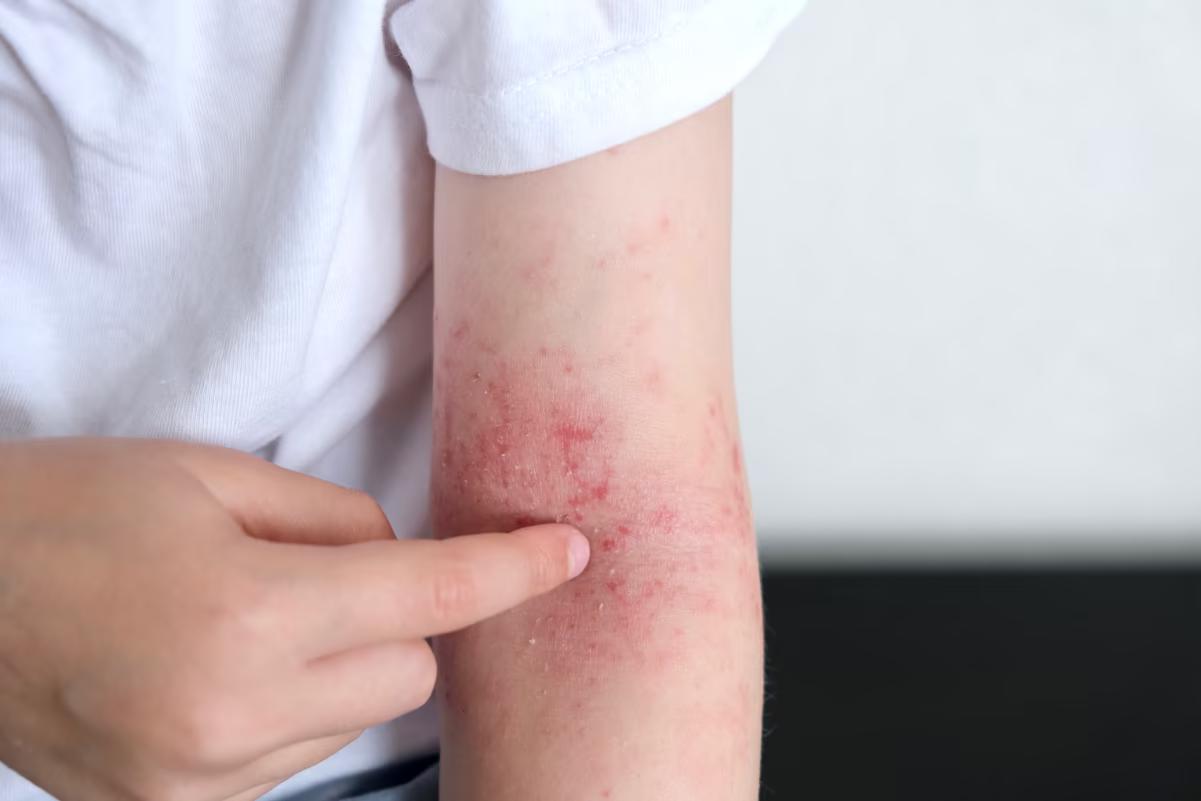
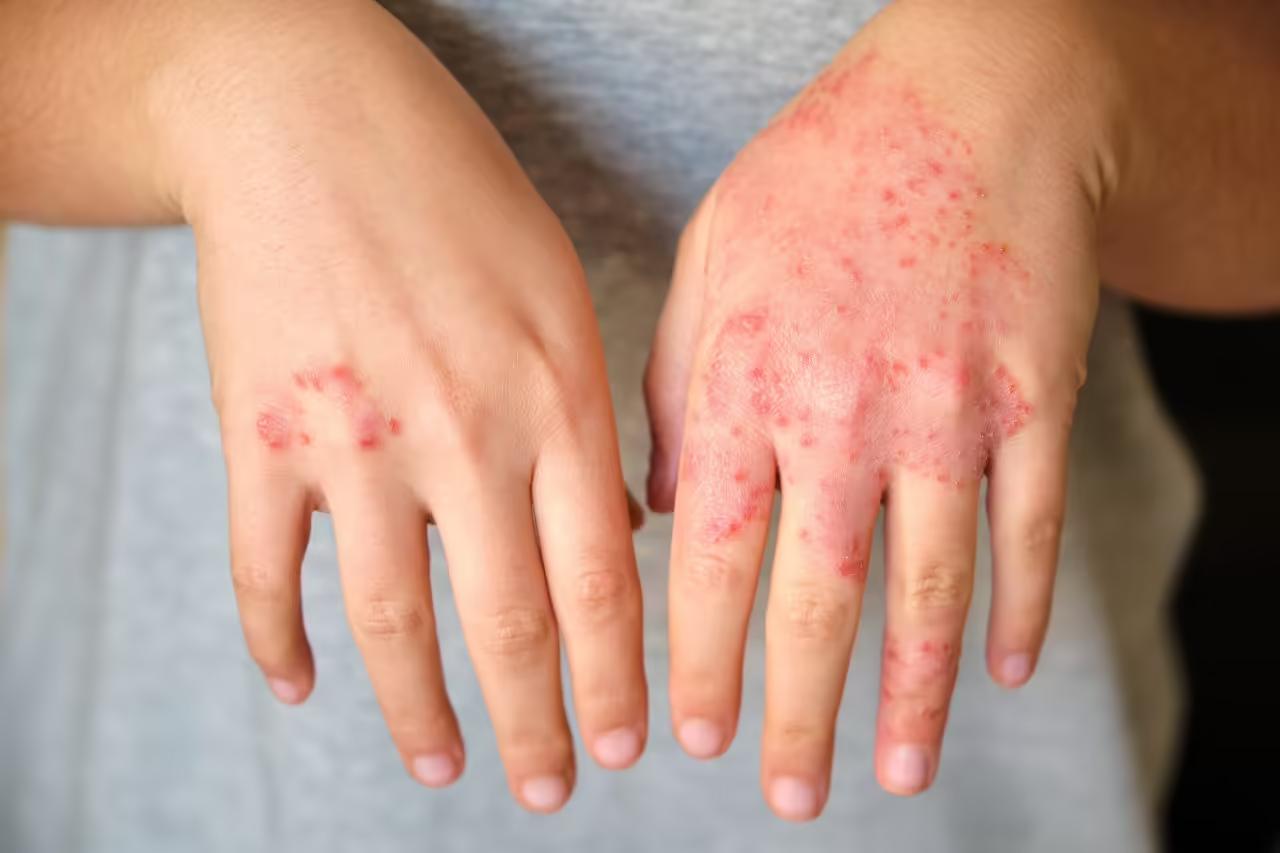
Patients with eczema clinically present with chronic, relapsing and intensely itchy (pruritic) patches of dry, inflamed skin. Key features include erythematous papules (small raised bumps on the skin), vesicles (fluid-filled blisters on the skin), scaling and, in chronic cases, lichenification (thickening of the skin).

The site of involvement varies. In infants it is typically across the cheeks and the extensor surfaces of the knees and elbows; in children and adolescents it commonly affects the flexural surfaces, behind the knees and elbows. In adults it is similar to adolescents, but commonly affects the hands and eyelids with more chronic and thickened patches.Source: Overview: Eczema – InformedHealth.org – NCBI Bookshelf (opens in a new tab)

Eczema is a clinical diagnosis, based on the classical chronically relapsing itchy rash with a typical morphology in the areas of the body described above, depending on the person’s age. Skin biopsies are rarely needed but may be used to rule out other conditions. Allergy or blood testing may be used if allergic dermatitis is suspected, to check for any underlying allergies.Source: Allergic Contact Dermatitis – StatPearls – NCBI Bookshelf (opens in a new tab)

Eczema is a chronic condition, and treatment is around management rather than cure. The main management and treatment protocols include hydration and topical anti-inflammatory medications in acute flare-ups.

For severe cases, phototherapy and systemic medications may be considered. Phototherapy involves the therapeutic use of non-ionising radiation, particularly within the ultraviolet spectrum, to reduce skin inflammation and alleviate symptoms. In appropriate patients, dupilumab is the primary, highly effective biologic treatment for severe cases of eczema that have not responded to other initial management options. This is a targeted biological therapy that targets two specific key signalling proteins (interleukin-4 (IL-4) and interleukin-13 (IL-13)), which are overactive in eczema.Sources: A Comprehensive Review of Phototherapy in Atopic Dermatitis: Mechanisms, Modalities, and Clinical Efficacy – PMC (opens in a new tab); Systemic treatments for eczema: a network meta-analysis – PubMed (opens in a new tab); Dupilumab – StatPearls – NCBI Bookshelf (opens in a new tab)

What We Help With

Other Skin Conditions

Explore the other Skin Issues conditions we assess and treat.

Move Better. Live Brighter.

Expert care for today. A healthier tomorrow.

Book an appointment

Patient Reviews

Real People.Real Results.

Hear from patients who have trusted Clinic 360 with their care.

5.0from 6 Dermatology Reviews

  • Dermatology Review

    I would like to recommend Dr K Bhatti - Consultant Dermatologist, he left no stone unturned all my 5 months of upset and stress over my skin condition was worth every penny of the consultancy fee so if your worried about a skin complaint, i have a longish wait to go but all my extra worry has gone as Dr Bhatti listens, very helpful cannot thankyou enough

    Lisa kincaidClinic 360 patient

Book an Appointment

Expert Care Starts Here

Book online and take the next step towards your wellbeing.

  • QuickBooking
  • Secure& Private
  • ExpertSupport

Accreditations & memberships

  • British Association of Sport and Exercise Medicine
  • Faculty of Sport and Exercise Medicine UK
  • British Association of Dermatologists
  • Royal College of General Practitioners
  • General Medical Council
  • Health and Care Professions Council
  • Chartered Society of Physiotherapy
  • Care Quality Commission
  • Verified on Doctify